
American ingenuity is ushering in an era of rapid acceleration in the fight against malaria. Private companies, research institutions, and universities across the United States are making scientific breakthroughs and tapping into the power of new technologies like artificial intelligence (AI) to take on this deadly disease. From new vector control tools that stop mosquitoes before they bite to breakthrough vaccines and new treatment options, the growing pipeline of malaria tools is transforming what’s possible.
Malaria No More recently teamed up with United to Beat Malaria to host a World Malaria Day Exhibition on Capitol Hill, spotlighting U.S.-led malaria research and innovation that is bringing us closer to elimination. With a presence in 17 states spanning the country, the companies, institutions, and universities that joined the exhibition are working across the full spectrum of the disease — from vector control to prevention, diagnosis, treatment, and surveillance.
Learn more about these American-led malaria breakthroughs and the innovators behind them:
Artificial Intelligence (AI)
Both Zzapp and Vectech, Inc. are using artificial intelligence (AI) to optimize vector control operations. Zzapp’s AI analyzes satellite images and topographical maps to more accurately locate malaria hotspots. By using Zzapp’s map-based mobile app, local officials can access the information to better target interventions. In Maryland, Vectech, Inc. pioneered an AI-powered system that identifies vector species known as IDX. The company has engaged with the U.S. government, including the U.S. Departments of Agriculture and Defense, and it’s IDX system boasts a 95% accuracy rate across over 70 mosquito and tick species — giving any user the identification capabilities of a medical entomologist.


Diagnostics
In Massachusetts, Thermo Fisher Scientific developed a real-time PCR solution to detect malaria with sensitivity and specificity. A PCR, or polymerase chain reaction, test can pick up small amounts of genetic material from pathogens — in this case, malaria parasites. Thermo Fisher Scientific’s custom TaqMan gene expression assay for malaria delivers accurate identification and quantification of malaria parasites and can be tailored to meet research needs.

Discovery Research
From coast to coast, some of the United States’ leading universities and research institutions are on the forefront of malaria research. In Maryland, Johns Hopkins Malaria Research Institute and the University of Maryland School of Medicine’s Center for Vaccine Development and Global Research are both advancing our understanding of the disease. Across the country, in Washington, the Seattle Malaria Clinical Trials Center is similarly driving scientific progress forward. All three institutions are working in partnership with the federal government, including the U.S. Department of Defense and the Joint Warfighter Medical Research Program alongside the National Institutes of Health and Centers for Disease Control and Prevention (CDC).


Gene Drive
Working with the CDC and the CDC Foundation in Georgia, Target Malaria is advancing cutting-edge science to tackle malaria at the source: stopping the mosquitoes that spread malaria parasites. After genetically modifying mosquitoes to lay fewer eggs, gene drive technologies can help ensure that new genetic traits are passed down to subsequent generations — rather than by chance. Although still being carefully tested in lab settings, gene drive has the potential to help us finally wipe malaria off the map.

Insecticide-Treated Fabrics
PATH is working with South Carolina-based Anovotek, LLC to develop novel Repellent Treated Fabrics (RTF) designed for use in U.S. military uniforms and equipment. Together, they are helping to keep our men and women in uniform safe from biting insects and the deadly diseases they carry.
Could the same insecticides used to treat military uniforms be used to treat cloth baby wraps? That was the question researchers at the University of North Carolina at Chapel Hill set out to answer, and the result was a resounding yes. Now Florida-based Sawyer and Lesu, which has a presence in Maine, Mississippi, and North Carolina, are working to scale the distribution of Permethrin Baby Wrap Kits — offering moms a cost-effective and easy-to-use new tool to protect their babies from malaria.


Long-Acting Injectables
Medicines for Malaria Venture (MMV) is pioneering a long-acting injectable for malaria prevention with Oregon Health & Science University and the Calibr-Skaggs Institute for Innovative Medicines in California. The possibility that a single injection — delivering one prophylactic dose of medication — could protect people from malaria for up to three months would be a game changer for prevention. This innovative new tool is being developed with support from the U.S. Government, including the Department of Veterans Affairs.

New Treatments
As antimalarial drug resistance grows, many of the malaria treatments we rely on today are at risk of becoming less effective. With a presence in New Jersey and Pennsylvania, Merck is just one example of a U.S. company pursuing other antimalarial drug candidates to get ahead of this growing challenge. Another example is Novartis, which recently announced promising Phase III trial results for a brand-new antimalarial known as ganaplacide/lumefantrine — the novel ingredient, ganaplacide, was discovered in a lab in California. Novartis also has a presence in New Jersey and Massachusetts, and the company just announced that the World Health Organization (WHO) prequalified Coartem® (artemether-lumefantrine) Baby, the first and only antimalarial developed specifically for newborns and young infants.


Next-Generation Bed Nets
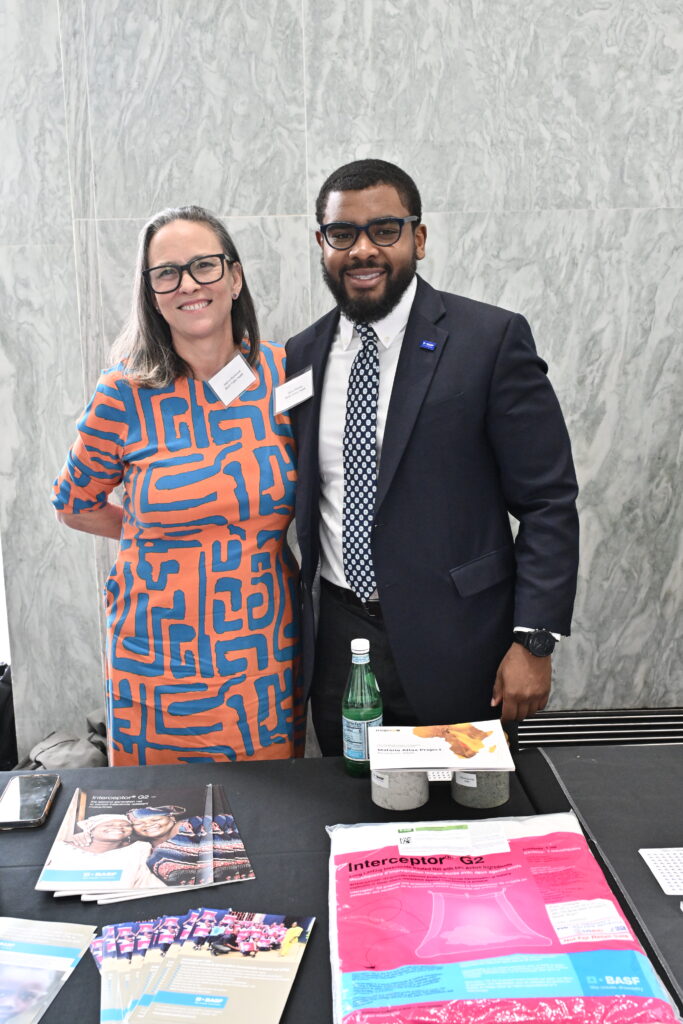
Mosquitoes carrying deadly diseases like malaria are evolving to evade conventional insecticides — rendering lifesaving tools like bed nets less effective. BASF Public Health has developed a next-generation net known as the Interceptor® G2 that can kill insecticide-resistant mosquitoes. This first-in-class dual active ingredient insecticide-treated net was shown to cut malaria cases in half in randomized control trials. The U.S. President’s Malaria Initiative (PMI) and the CDC supported the development of the Interceptor® G2, and PMI has procured millions for malaria endemic countries facing insecticide resistance.
Vaccines
Maryland-based Sanaria, Inc. is developing several groundbreaking malaria vaccines. Just a few years after the WHO recommended the first-ever malaria vaccine for widespread use in 2021, Sanaria is pushing the bounds of science with a promising new suite of vaccines in the pipeline. One such vaccine, the PfSPZ-LARC2 Vaccine, achieved an impressive 90% protection against controlled human malaria infection (CHMI) and as a single-dose vaccine, it has clear advantages over current multi-dose regimens.

Vector Control
In Wisconsin, SC Johnson has introduced a groundbreaking new vector control tool, the Guardian™ Spatial Repellent. Smaller and easier to use than a bed net, Guardian™ has the potential to be a powerful new tool to prevent biting indoors — from homes to schools, workplaces, and more. Another Midwest company with a presence in Illinois and Iowa, Valent Health is tackling mosquito management outdoors — addressing the full life cycle of the mosquito. At the same time, Florida-based Westham, Co. developed the ATSB® Sarabi Bait Station. Supported by the U.S. Department of Defense’s Deployed War-Fighter Protection, it provides a low-cost and lightweight method to bait the mosquitoes that carry malaria.


About Malaria No More
Malaria No More envisions a world where no one dies from a mosquito bite. Twenty years into our mission, our work has helped drive historic progress toward this goal. Now, we’re mobilizing the political commitment, funding, and innovation required to achieve one of the greatest humanitarian accomplishments of our time — ending malaria for good.