
For many faith leaders, malaria elimination is not just a public health goal, it is a moral imperative. As Bishop Dinis Matsolo explains, “If something causes suffering among the people, then it automatically becomes part of the agenda for religious leaders.”
It’s not hard to understand why. Amu Mudenda notes, “They are the ones who visit the sick, who carry out services when someone has died. They are the ones who care for those communities.”
Through their respective roles as Executive Director of the Programa Inter Religioso Contra a Malaria (PIRCOM) and as Regional Coordinator for the Faith Leader Advocacy for Malaria Elimination (FLAME) Secretariat, both Anglican Bishop Dinis Matsolo of Mozambique and Amu Mudenda of Zambia shared their experiences working to curb malaria with people of diverse faiths on a recent panel.
Hosted by Georgetown University’s Global Health Institute and organized by Friends of the Global Fight Against AIDS, Tuberculosis and Malaria, in partnership with Malaria No More, the panel explored themes raised in the report, “Making Country-Led Malaria Control a Reality.”
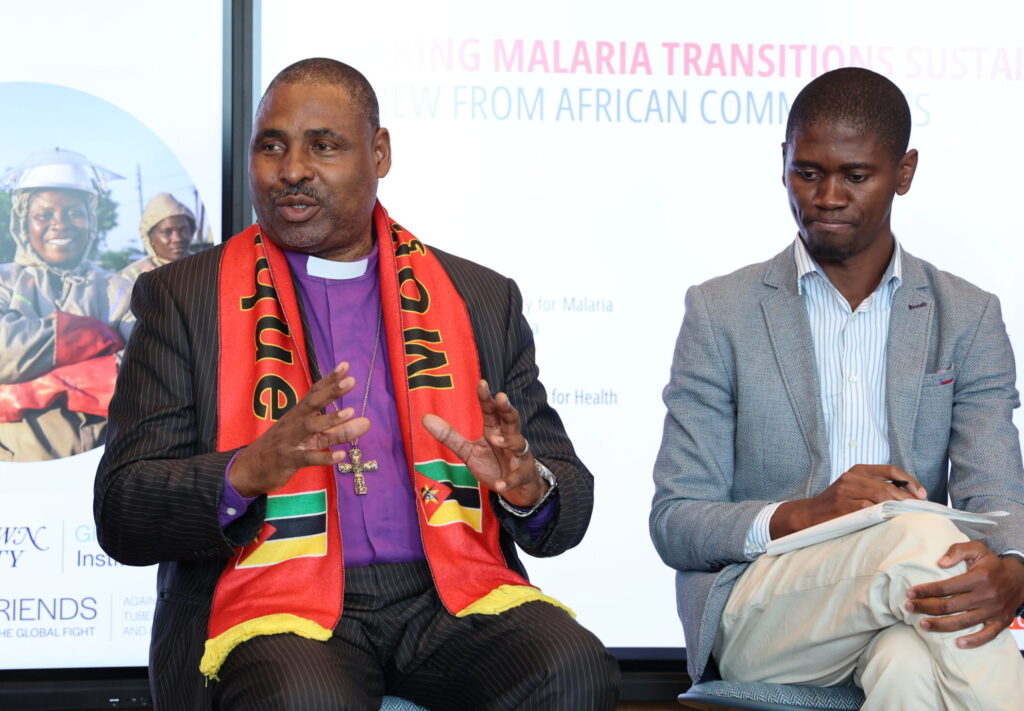
After years spent bringing faith communities — whether Christian, Muslim, Hindu, or Baha’i — together across Africa, Bishop Matsolo and Mudenda have seen firsthand how effective faith leaders can be as health messengers, advocates, and champions of accountability.
As countries across the African continent continue to transition toward greater country ownership of malaria programs under the America First Global Health Strategy, faith leaders play a vital role in delivering responsible, sustainable transitions.
Faith Leaders as Trusted Health Messengers
Trusted by those they serve, faith leaders have frequent touchpoints and strong connections within communities that allow them to relay vital health information. They often educate on the importance of using bed nets, clearing standing water and what to do when someone in the family spikes a fever.
Importantly, religious leaders can deliver this lifesaving information in even the hardest-to-reach places. “There are places in our countries, and I’m not only talking about Mozambique, where our health systems are very weak,” shares Bishop Matsolo. “But even in places with no government presence whatsoever, you will find a church, a mosque, or a synagogue.”
Strengthening and leveraging existing religious networks to reach the most vulnerable is at the heart of Programa Inter Religioso Contra a Malaria’s (PIRCOM) mission, the organization Bishop Matsolo now leads. Launched in 2006 with support from the U.S President’s Malaria Initiative (PMI), PIRCOM has helped more than 27,000 Christian, Muslim and Baha’i faith leaders reach nearly two million congregants with basic malaria education.


Faith Leaders as Health Advocates
Not only are they effective health messengers, faith leaders are also effective advocates for their communities. By alerting the government if homes are missed during bed net distribution or indoor residual spraying campaigns, they can help close gaps in coverage — ensuring no one is left behind.
Mudenda recalls a faith leader in northern Zambia who noticed mosquito nets being sold, rather than distributed free of charge by the government. Because many families can’t afford to purchase a net, this was a serious setback for malaria control efforts in the area. The faith leader flagged the incident for the government, which ultimately resolved the issue and resumed the free distribution of nets in the community.
In another example, Mudenda explains how a faith leader stepped in when local health facilities were facing chronic stockouts, or shortages, of malaria prophylaxis for pregnant women. Because pregnant women and their unborn children are at high risk for life-threatening complications, preventative malaria treatment is dispensed free of charge. The local faith leader escalated the issue all the way to the Minister of Health. With support from the U.S., the Minister increased procurement of the drug, which was found to be in short supply throughout the country.
Faith leaders also have a strong convening power, which they can use to bring other partners into the malaria fight, like the private sector. Mudenda recalls a meeting held by faith leaders to highlight Zambia Sugar’s investments in malaria. According to Mudenda, the company went from seeing 660 cases of malaria for every 1,000 employees in 2000 to only two out of every 1,000 employees falling ill in 2023.
Bishop Matsolo wants to share the economic benefits of investing in malaria far and wide. “Imagine what will happen if key staff get malaria and stay home for two weeks,” he says, unpacking why malaria investments are good for the bottom line. “It’s a problem for the company,” he adds.
Faith Leaders as Partners for a Malaria-Free Future
While Africa continues to bear the highest malaria burden — accounting for 94% of all cases in 2024 — the risks and opportunities of malaria elimination extend far beyond African shores. That’s the message Bishop Matsolo says he brought to U.S. policymakers in his meetings on Capitol Hill. No one country or continent can go it alone, and the United States, too, stands to win or lose in the global malaria fight.
“Our message is not that U.S. funding should continue forever,” explains Bishop Matsolo, “we are not praying for perpetual dependence.”
“But the transition must be gradual,” he adds, “It has to create space for sustainability so that we don’t lose everything we have worked so hard to gain.”
Mudenda agrees, underscoring that transitions must account for differences across countries, noting that Zambia is not the same as Angola nor the Democratic Republic of the Congo.
No two countries face the same set of challenges or opportunities. But Mudenda is adamant that in every context, civil society engagement — including faith-based organizations — is a value add for malaria control. Indeed, the report underpinning the panel is clear that governments of malaria endemic countries should continue to leverage faith networks as effective partners during — and after — the transition to country ownership.
That means investing in faith-based organizations so they have the resources to deliver. After losing U.S. Government funding in 2025, Bishop Matsolo’s PRICOM was forced to reduce staff from 72 to just five — significantly hindering the organization’s reach in a large country like Mozambique.
“We’ve come a long way,” says Bishop Matsolo, reflecting on decades of progress in the fight against malaria. “We have come to the point where we can see the end. If we stop now, we will lose everything.”
A future with malaria is not one Bishop Matsolo is willing to entertain.
“A new generation will ask how we let a disease that can be prevented — cured, even — kill so many people,” he says.
We have the tools, expertise, and progress needed to significantly reduce this disease and bring us closer to ending it. A future where no one dies from a mosquito bite is within reach — and faith leaders will be key partners in that effort.

Photo Courtesy of the Georgetown University Global Health Institute.
About Malaria No More
Malaria No More envisions a world where no one dies from a mosquito bite. Twenty years into our mission, our work has helped drive historic progress toward this goal. Now, we’re mobilizing the political commitment, funding, and innovation required to achieve one of the greatest humanitarian accomplishments of our time — ending malaria for good.