
Home to a sweeping stretch of the Amazon rainforest, Guyana’s stunning landscape also complicates efforts to eliminate malaria. Enter Amp Health, which in partnership with the National Malaria Programme, piloted a new AI-powered chatbot to support those on the frontlines of the malaria fight in Guyana. We spoke to Andeh Hyeroba who supported the project as Amp Health’s Management Partner embedded with Guyana’s Ministry of Health to learn more about the power and potential of this new tool.
What makes malaria elimination in Guyana so challenging?
Guyana is a very big country, but its population is small — under one million people. Only about 15% of the country’s land mass is inhabited, and most people live in urban centers. The other 85% of Guyana’s land is primarily Amazon rainforest.
The malaria problem in Guyana stems from the fact that people undertake economic activities in and around the rainforest where they are exposed to malaria-carrying mosquitoes. Mining in particular carries a high risk. Rivers, where most mining takes place, are perfect breeding sites for mosquitoes. There is also very little infrastructure, so miners are unlikely to sleep under insecticide-treated bed nets. And government officials and health workers are often unable to enter mining sites or nearby communities.
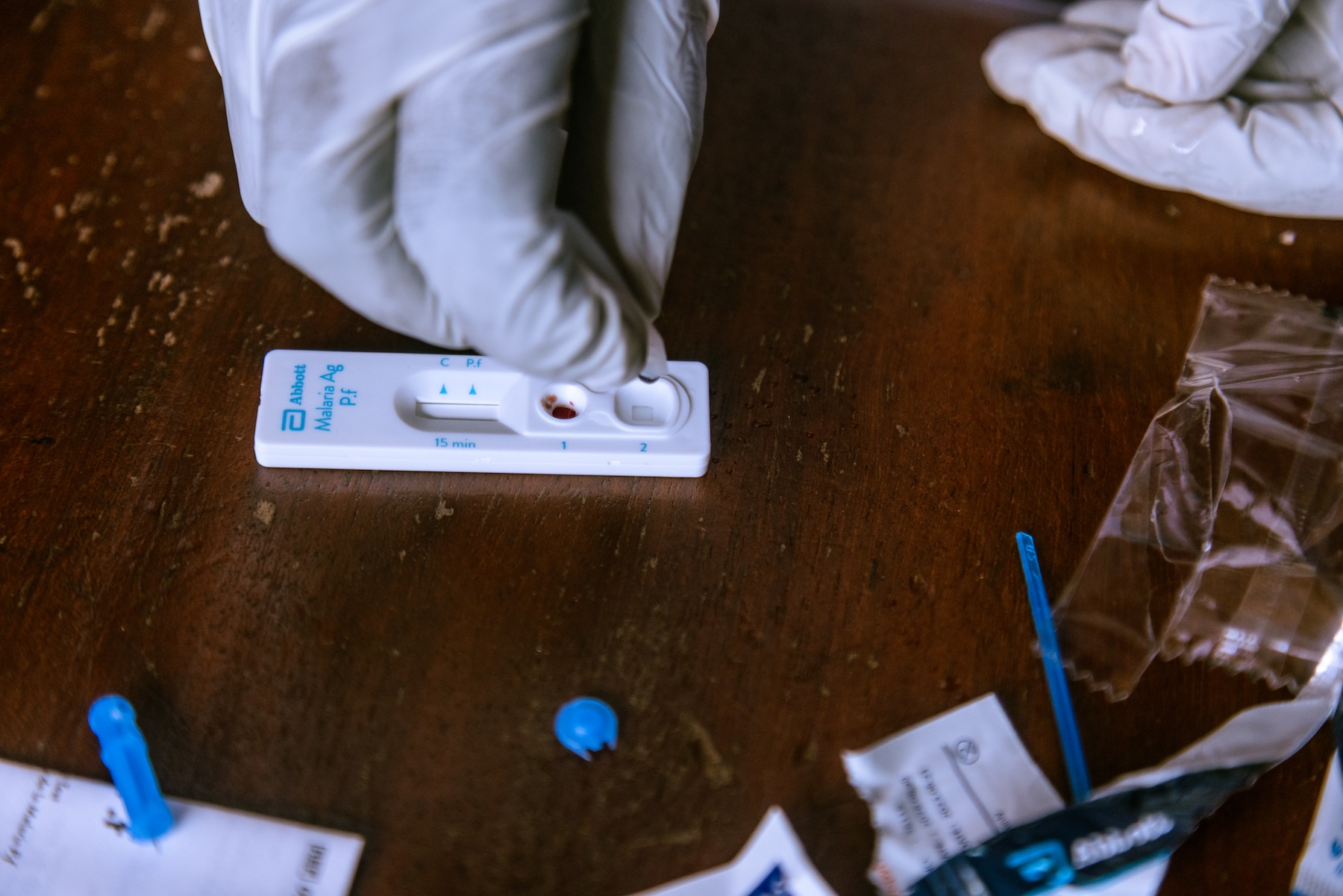
The government worked hard to gain access to mining communities while I was with the Ministry of Health. A memorandum of understanding between the government and mining operators led to voluntary malaria testers. Nominated by the mining operators but trained and equipped with medical supplies by the government, these volunteers are responsible for testing and treating malaria in mining communities.
Guyana also has multiple strains of malaria. There is Plasmodium falciparum, which is very common in Africa and although deadly, can be treated in three days. There is also Plasmodium vivax, the predominant strain in South America, which is treatable over a longer period. Longer treatment requires more medication, which puts added pressure on health services to distribute and maintain supplies. That’s difficult in a country like Guyana.
There are very few roads in the rainforest, which means the primary means of transportation is via either water or air — boat or plane. Imagine taking a two-hour flight, then driving 50 kilometers before getting in a boat for another two hours to reach a health center. That makes some globally-recognized best practices — like reporting malaria data daily, for example — next to impossible.

How is Guyana using Artificial Intelligence (AI) to overcome some of these challenges?
Every time Guyana’s national malaria treatment guidelines were updated, they were printed, shipped, and carried by voluntary malaria testers and community health workers as they traveled across Guyana’s rivers and rainforest.
We asked ourselves: how can we overcome shipment delays, supply chain challenges, and the costs involved in distributing these paper guidelines? And what if volunteers needed additional guidance for a complicated case? Would they have to call the national referral hospital every time? That was how the idea for an AI-powered chatbot was born.
How does the chatbot work?
The chatbot’s knowledge base is the Ministry of Health’s approved malaria treatment guidelines, so when a user asks a question, the chatbot immediately retrieves the information from the national guidelines.
If a voluntary malaria tester or health worker encounters a tricky case, the chatbot can provide guidance. For example, if a pregnant 15-year-old tests positive for malaria the chatbot can outline the appropriate next steps. Normally you would test and treat, but in this situation the patient needs to be referred to the hospital. In fact, any patient who is pregnant or 15-years-old or younger cannot be treated by voluntary malaria testers. That’s unique to Guyana because we have multiple strains of malaria, so further testing is needed to determine if it’s P. vivax or P. falciparum — or both.
It makes a big difference to have the most up-to-date information available at your fingertips. I’ll give you a critical example. The World Health Organization updated its malaria treatment guidelines to recommend tafenoquine as a course of treatment for P. vivax, which has its own treatment protocol. Without the chatbot, updating the national malaria guidance would mean printing and shipping new pamphlets, which could take up to six months. Imagine how many infections occur in six months. That’s the advantage of this being a digital product, and Guyana’s unique context makes this especially relevant.
What infrastructure is needed to support the chatbot?

Right now, the chatbot is available through WhatsApp and uses a cloud hosting service. At the end of the pilot, the government of Guyana shared its intent to transition to local hosting. However, this hinges on a government-wide digitization project, so it won’t happen overnight. The government was also working to expand internet access via Starlink by the time I left Guyana, with a goal of getting all health facilities online within three years.
At the World Health Assembly in May 2026, Guyana’s Minister of Health cited the WhatsApp chatbot as an example of the country’s recent success in combatting malaria. So, from a government ownership point of view, it still seems to be moving in a good direction.
Once the digitization process is complete in Guyana and Starlink has expanded internet access across all health centers, the chatbot will only cost the government about $5,000 per year — and would save the cost of frequent printing and shipping.
How scalable is this? What’s next for this project?
We applied learnings from Guyana to pilot a similar chatbot in Malawi, where I’m currently based, but this time it is being used for Mpox and cholera. It’s a very scalable tool because you can expand the treatment guidelines to enable the chatbot to address questions on HIV or tuberculosis, for example. Now, it’s worth noting that this is a tool for health professionals, not patients, so there’s a lot of technical jargon involved. But it can serve as a repository of easy-to-access information on government approved treatment protocols for all kinds of diseases, and that’s really exciting.
While we evaluate the chatbot’s ability to address multiple diseases in Malawi, we’re already looking at how this can be implemented in other countries because it’s very adaptable. One of the biggest bottlenecks we’ve encountered as we’ve scaled this pilot are concerns around data protection. As a result, governments want services to be hosted in-country, which requires more advanced infrastructure. But once you have buy-in from leadership, like we’ve recently seen in Ghana, governments will move quickly and ultimately, it’s country ownership that really makes this successful.

About Malaria No More
Malaria No More envisions a world where no one dies from a mosquito bite. Twenty years into our mission, our work has helped drive historic progress toward this goal. Now, we’re mobilizing the political commitment, funding, and innovation required to achieve one of the greatest humanitarian accomplishments of our time — ending malaria for good.