
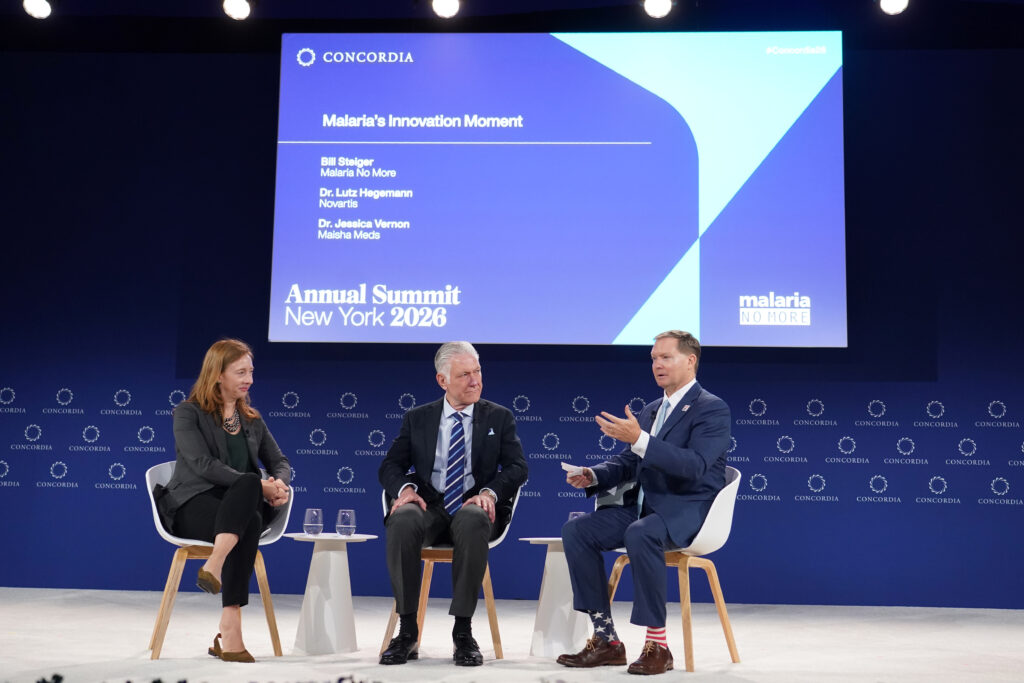
Amid the 81st session of the UN General Assembly (UNGA 81), Malaria No More convened private sector leaders for an innovation-focused panel at Concordia’s Annual Summit in New York City.
With a growing pipeline of new tools and technologies poised to radically accelerate progress against malaria, the private sector will be essential to ensuring groundbreaking innovations are scaled — with speed. Dr. Bill Steiger, CEO of Malaria No More, was joined onstage by Dr. Lutz Hegemann, President of Global Health and Swiss Country Affairs for Novartis, and Dr. Jessica Vernon, CEO of Maisha Meds to unpack the private sector’s role in turning recent malaria breakthroughs into impact.
Here is what we heard:
Malaria Demands Global Attention
Hegemann reminded the audience that “malaria is one of the oldest, but also one of the deadliest diseases that is known to mankind. And it still kills about 600,000 people every year, which is a staggering number and has a profound impact on communities in Africa and beyond.” He then pointed out that “the disease pattern [is] changing as a consequence of changing climate patterns, forced migrations,” adding that it was “just a few weeks ago that two people died of malaria at the Frankfurt airport … which you wouldn’t expect, so we shouldn’t be thinking of malaria as a disease that’s far away.”
“Economic growth is a big factor that is affected by malaria,” said Vernon. “People who have malaria often cannot work as hard, cannot go to school, cannot pay as much attention in school because they’re sick, and as a result, you see reduced growth in certain parts of the world where there [are] higher rates of malaria.”
Resistance Is Rising, New Antimalarials are Needed — Fast
“We shouldn’t be surprised that resistance against current antimalarials is rising … because that has happened over time to every other antimalarial medicine that was ever in use,” explained Hegemann. “Because the parasite is a clever fellow, and they of course try to adapt to the ecosystem and try to survive as much as we want to kill it.”
“We need to use our best science to be a step ahead of the parasite,” added Hegemann. “That’s what we’ve been doing now for many years, by doing targeted drug discovery, to develop that next generation of antimalarial, which is now in [the] regulatory approval process, and we are confident and hopeful that it can be deployed in time before the spread of resistance becomes more widely and more deadly to those affected.”
The Private Sector Is Key to Healthcare Delivery Across Africa
“We work with about 6,000 pharmacies, clinics, and drug shops across four countries in Africa,” shared Vernon. “We see about 35 million patient encounters every year. About 12% of those are malaria, so it’s a very large dataset that we’re able to work with.”
“We’re seeing really interesting trends that aren’t being surfaced elsewhere,” she continued. “As resistance is starting to emerge in some regions, we’re seeing that patients are going in to buy different drugs already … This is a big and emerging problem … and we’re able to target where drugs should be used based on the data we’re seeing around consumption.”
In an Era of Declining Resources, Innovation Can Increase Impact
“I think this is one of the most exciting times in terms of the innovations that are coming online — ganaplacide/lumefantrine, the spatial emanators that SC Johnson’s putting out, some new bed nets and other things,” said Vernon. “It’s also a time when there are a lot of headwinds in how we fund these things. We are excited to be able to provide some of the targeting and support to make that happen.”
“I think for a long time we have looked at malaria as a homogeneous disease entity,” reflected Hegemann. “But in today’s world, it’s a lot more differentiated. We have countries that are nearing elimination, and we’ve seen countries actually eliminate malaria in recent years, and then we still have high-burden situations. We have outbreaks, for instance, in zones of conflict … It’s not one silver bullet, but we need a whole toolbox that can be deployed in a data-driven and locally led approach to precisely address the need of that population at the time.”
What it Will Take to Meet Malaria’s Innovation Moment
“I think it’s fair to say that having not had a new innovation in malaria treatment for 25 years, I think the world has lost a bit [of] its organizational memory [about] how to bring those innovations to patients in need quickly, and that’s why we need to start discussing very broadly with all stakeholders involved how we can accelerate that process,” said Hegemann.
“I think we have kind of two directions to go in,” Vernon said. “Do we want to engage with all of these amazing tools and take them to scale, and make sure that they’re available, or let the work over many years to bring [these tools] to market not get the support it needs.”
She added: “I hope, and I believe, that there is a lot of appetite and will to make these innovations reach communities … local governments are wanting and empowered to engage in a way that maybe they haven’t been before, and to really think about what the right tools are for them. It’s an incredible piece of the puzzle moving forward.”
“I believe that technically we are better equipped now than we were ever before,” said Hegemman. “But we need to find a way to deploy new technologies in a very responsible and in a very efficient way, and of course we need to sustain the basic quality and ability of a healthcare system to deliver those new innovative technologies, and that does require continued funding as well.”
He concluded: “We have the tools now. We need to create the appropriate ecosystem, and then we’ll see the populations benefit.”

About Malaria No More
Malaria No More envisions a world where no one dies from a mosquito bite. Twenty years into our mission, our work has helped drive historic progress toward this goal. Now, we’re mobilizing the political commitment, funding, and innovation required to achieve one of the greatest humanitarian accomplishments of our time — ending malaria for good.