
Dr. Kaushik Sarkar, Founder and Director of the Institute for Health Modeling and Climate Solutions (IMACS) joined a panel discussion at the Global Health Security Conference 2026 in Kuala Lumpur, Malaysia alongside Dr. Tracey Thornley from the University of Nottingham and Jane Blake from Jacobs. The panel, “Biosurveillance of the Future: Boundless technologies, bounded data, can the two co-exist?” explored what it will take to deliver a fully connected global health surveillance system.
Rapid technological advances and artificial intelligence (AI) have redefined what’s possible when it comes to disease surveillance. And yet, despite more data than ever before and AI models that can predict outbreaks before they start, crucial early signals are still missed and responses delayed, explained Dr. Nino Kharaishvili from Jacobs in her opening remarks as moderator.
“This is not a technical failure, it is a systematic failure,” she said.
In a three-part discussion, panelists shared their take on what’s needed to turn our fragmented system into a fully integrated, global disease surveillance system that leverages the full power of artificial intelligence to not only predict but inform.
Because as Dr. Kharaishvili said while introducing Dr. Sarkar, “Detecting outbreaks is no longer enough. If our systems cannot anticipate, explain, and guide decisions, they are already obsolete.”
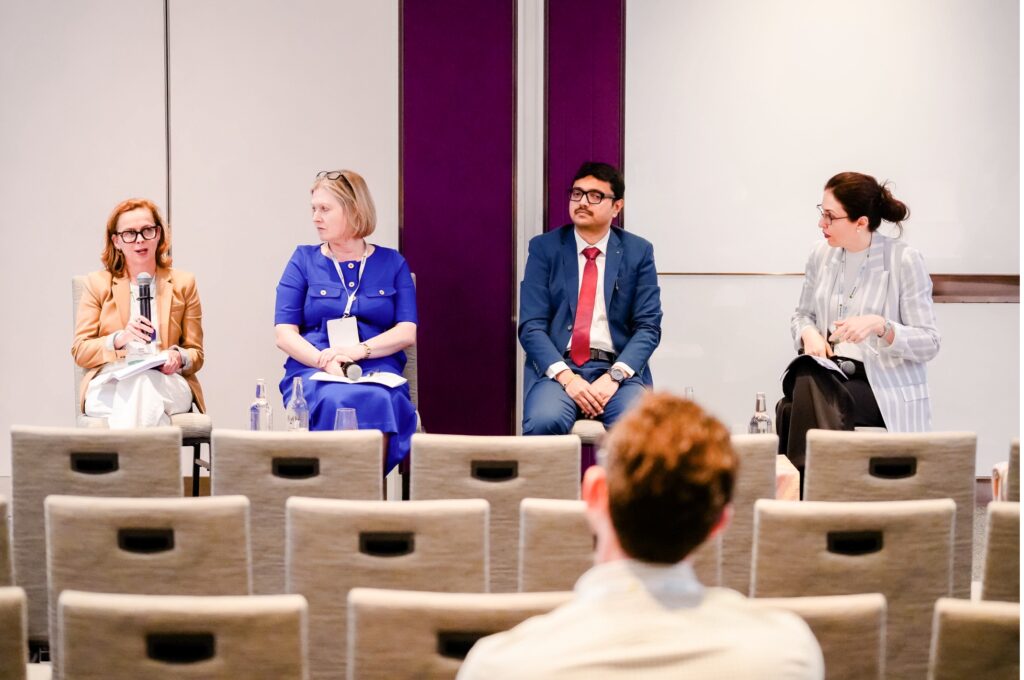
Here is what we heard:
Dr. Kaushik Sarkar, Director – IMACS
- “Prediction of a problem is not enough. As we have seen in multiple instances … We do have prediction, we do have data, but we do not have adequate inputs to address the challenge.”
- “With the availability and accessibility of foundation models, we are now capable of gathering every single data that exists in the world … over the past year [IMACS] worked with Amazon and Patrick J. McGovern Foundation to develop a system that works around 570 terabytes of data, more than 5 million full text articles, 40 million abstracts to bring in over 45,000 variables together, their relationships and reason around that. The outcome is that now in hours to days, we can produce any and all dashboards that are required for intelligence reports.”
- “The breakthrough innovation that has happened in the world is something called embedding … there are many types of data sets, like genomic data sets, social signals, climate data, other forms of environmental data, geospatial data. These are all different languages … Embedding … translate[s] these languages into a common mathematical space. The moment you do that, you can then reason across all different domains together, and you do not need to rely on a single isolated data set to make a prediction.”
Professor Tracey Thornley, Pharmacist and Health Economist, Professor of Health Policy – University of Nottingham
- “We are at a moment where biosurveillance technologies are effectively boundless— we have advances in artificial intelligence, mobility data, and open-source intelligence that were unimaginable even a decade ago. But the data we need to power these systems remains bounded — by governance constraints, trust, and fragmentation across sectors and institutions. So the real question is not whether the technology works. It is whether our systems and governance are evolving fast enough to use it.”
- “People are not entering the [health] system in the same way they did even five or ten years ago … Pharmacists are frequently the first point of contact for people experiencing early or mild symptoms. If we are serious about moving from reactive detection to anticipatory intelligence, then these are precisely the inputs our systems need.”
- “The barrier is not the absence of data. It is the absence of trusted mechanisms to use it … [because] early signals already exist. The real question is: Are our systems designed to see them?”
Jane Blake, Global Health Security Director – Jacobs
- “I’ve spent most of my career chasing that middle space — the place where curated and open source data connect to validate insights. None of this is new. What is new, however, is incredible and exponential advances in technology, AI, and data availability, quality, and sophistication.”
- “We need a hybrid approach, that middle space that capitalizes on open source and community signals but balances sovereignty, privacy, and global health security.”
- “Let’s keep promoting practical models that integrate governance lessons with aggregated surveillance, open‑source signals, and anonymized mobility to generate timely and actionable insights while minimizing sensitive data exchange.”
- “This can cut the reliance on single source, siloed systems and move us to hybrid, all hazards ecosystems. It can take us away from data exchange as the bottleneck and focus on insight sharing without full data sharing. In a hybrid model, we can begin to alleviate that central tension between boundless technologies and bounded data.”
About Malaria No More
Malaria No More envisions a world where no one dies from a mosquito bite. Twenty years into our mission, our work has helped drive historic progress toward this goal. Now, we’re mobilizing the political commitment, funding, and innovation required to achieve one of the greatest humanitarian accomplishments of our time — ending malaria for good.