Women scientists and researchers around the world are leading, innovating, and accelerating progress against malaria every day. Their work spans breakthrough treatments, transformative tools, and critical advances in research and disease control — reshaping what’s possible in the fight against malaria.
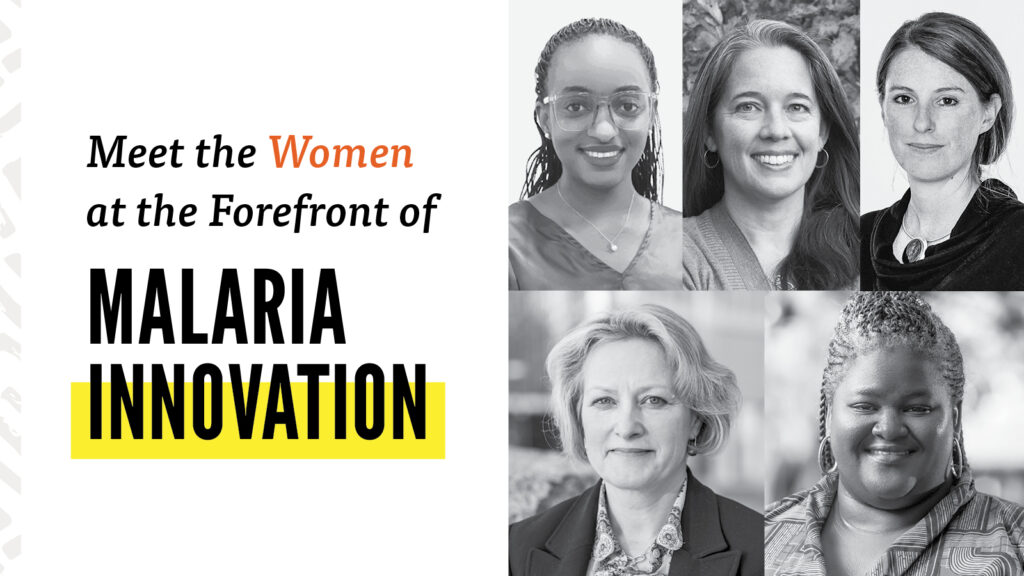
Through our Malaria Know More series, we’ve had the privilege of speaking with many of these phenomenal leaders. In honor of International Women’s Day, we’re highlighting five women whose conversations and contributions we’ve featured in recent months, and whose work is helping move us closer to ending malaria.
Caroline Boulton: New Malaria Treatment Shows Promise Against Growing Drug Resistance
Caroline Boulton, Global Program Head Malaria at Novartis, currently leads the development of the antimalarial portfolio at Novartis, including next-generation malaria treatment ganaplacide/lumefantrine. As antimalarial drug resistance grows, the treatment’s entirely new mechanism of action represents a powerful new tool to help outpace evolving malaria parasites. We spoke with Caroline about the nearly 17-year journey from discovering the novel ingredient in ganaplacide/lumefantrine in the lab to announcing promising Phase III trial results in November 2025.
Krystal Birungi: Behind the Science of Gene Drive
Krystal Birungi is a malaria advocate and entomologist at Target Malaria, working on one of the most promising innovations in the fight against malaria: gene drive. This breakthrough tool is designed to stop mosquitoes in their tracks and could change what’s possible in malaria prevention. We spoke with Krystal to understand how gene drive works, what gives her hope, and how science is bringing us closer to a malaria-free world.
Sophia Mwinyi: Harnessing Genomics to Support Malaria Control Efforts
In a discussion with Malaria No More, Dr. Fredros Okumu, one of Africa’s leading entomologists and Sophia Mwinyi, a Research Scientist at Ifakara Health Institute and a PhD candidate at the University of Glasgow, discuss using genomics to support global disease control efforts. Together, they recently published a new study that used advanced sequencing to uncover a new species of mosquito, which could prove critical to evolving malaria control interventions.
Courtney Murdock: Predicting Mosquito-Borne Disease Transmission to Address Urban Malaria
Dr. Courtney Murdock, an Associate Professor at Cornell University’s Department of Entomology and lab lead in Cornell’s Murdock lab, discusses her work to address malaria, including how changes in climate, land use, and other environmental variables influence the transmission and control of mosquito-borne diseases.
Wendy O’Meara: Kenya’s First Seasonal Malaria Chemoprevention (SMC) Pilot Program
In a discussion with Malaria No More, Professor Wendy O’Meara of Duke University, a lead malaria researcher, shares the results of Kenya’s first-ever Seasonal Malaria Chemoprevention (SMC) pilot project conducted in Turkana Central and how it demonstrated that it could reduce malaria cases in children by more than 70%.
About Malaria No More
Malaria No More envisions a world where no one dies from a mosquito bite. Twenty years into our mission, our work has helped drive historic progress toward this goal. Now, we’re mobilizing the political commitment, funding, and innovation required to achieve one of the greatest humanitarian accomplishments of our time — ending malaria for good.